
How to Identify Ripe Figs and Tips for Harvest Timing
Updated: 2026-07-13
Even when glancing up at the branches wondering "Is it ready soon?", figs do not ripen all at once. Green fruit swells, and then on a particular day becomes sweet and soft all at once. Early harvest results in watery fruit, while delayed harvest invites bruising and splitting. This article explains how to judge the optimal moment of full ripeness on the tree—the point of best flavor—using five signs: neck droop, eye opening, softening, color development, and honey content (sugar level)—as well as storage life after harvest.
Basics of Fig Harvest Timing
Figs produce two crops: the breba crop, which forms on the previous year's wood in early summer (around June–July), and the main crop, which forms on new growth from mid-summer through autumn (around August–October). Which crop develops depends on the variety and training method. Widely cultivated varieties in Japan such as Masui Dauphine and Toyomitsuhime, as well as Brown Turkey, which is recommended for beginners, produce mainly the autumn crop. Fruit ripens progressively from the lower part of the tree upward, so daily or every-other-day inspection is standard practice once the harvest period begins.
Sign 1: Drooping Neck
As ripeness approaches, the fruit's neck softens and thins, causing the fruit to droop under its own weight. When fruit that was once held upright on the branch begins to hang limply downward, this signals readiness to harvest. Varieties such as Yellow Long Neck with extended necks show this change clearly and are useful for practicing harvest timing.
Sign 2: Check the eye, color, and softness.
Eye opening (at the fruit apex)
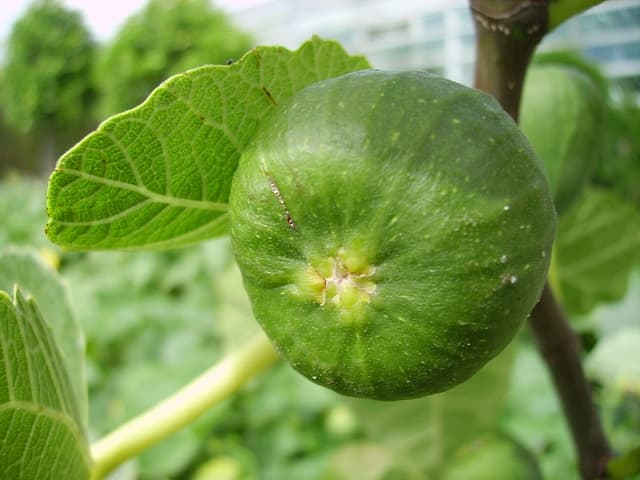
The "eye" (the opening at the fig's apex) swells and opens as the fruit ripens. However, varieties with large eye openings tend to crack in rain and are more susceptible to insect entry, while varieties such as Celeste have a more closed eye and greater resistance to splitting. The degree of opening that indicates ripeness varies by variety.
The skin colors up.
Observe whether the fruit has fully developed the color characteristic of its variety. Purple and black types should display deep, dark coloration, while yellow and green types will show a lighter base color with fine surface cracks (sugar cracks) appearing on the skin.
Yields to gentle pressure when ripe.
Gently pinch the fruit near the stem between the fingertips; when it reaches the softness of an earlobe, it is fully ripe. Fruit that feels hard and unyielding is still immature and will be watery with insufficient sweetness.
Sign 3: Check the Honey (Sugar Content)
The final sign of full ripeness is the appearance of honey. Transparent honey seeps from around the eye, gleaming like a jewel, and the skin develops a glossy appearance. In high-sugar varieties such as Black Madeira, Violette de Bordeaux, and Ronde de Bordeaux, this honey drip appears distinctly as a marker of full ripeness.
Harvesting Tips and Storage Life
- Harvest in early morning when temperatures are low to firm the fruit and extend shelf life.
- Cut the stem with pruning shears, or gently twist and lift upward by the stem to remove.
- White sap from unripe fruit and branches can cause skin irritation. Gloves are recommended for protection.
- Figs do not gain sweetness significantly after harvest, so ripening fully on the tree is essential.
Fully ripe figs bruise easily and keep for only half a day to one day at room temperature. Under refrigeration, wrap them to prevent drying and consume within 2–3 days as a guideline. Leftover figs can be made into jam, frozen, or dried to avoid waste.
When uncertain about the variety
The color at full ripeness, the degree of eye opening, and the sugar content vary by variety. When the variety of a tree on hand is unknown, or when narrowing down based on ripening characteristics, consulting the variety guide to search by fruit skin color or genetic line, or posting photos on the forum for review can assist in identification.
Check all five signs—neck droop, eye opening, softening, color development, and honey presence—to harvest fully ripe figs at peak sweetness without missing them. Avoid picking too early, but do not delay harvesting. Make daily inspection a routine habit to fully enjoy the figs' seasonal sweetness.
Related varieties
Not going the way you hoped?
Ask other growers on the board. A photo gets you a faster answer.
This article was drafted with AI assistance and reviewed by the site operator. Variety details are for reference—please confirm identification through discussion on the board.
Reply0
Login required